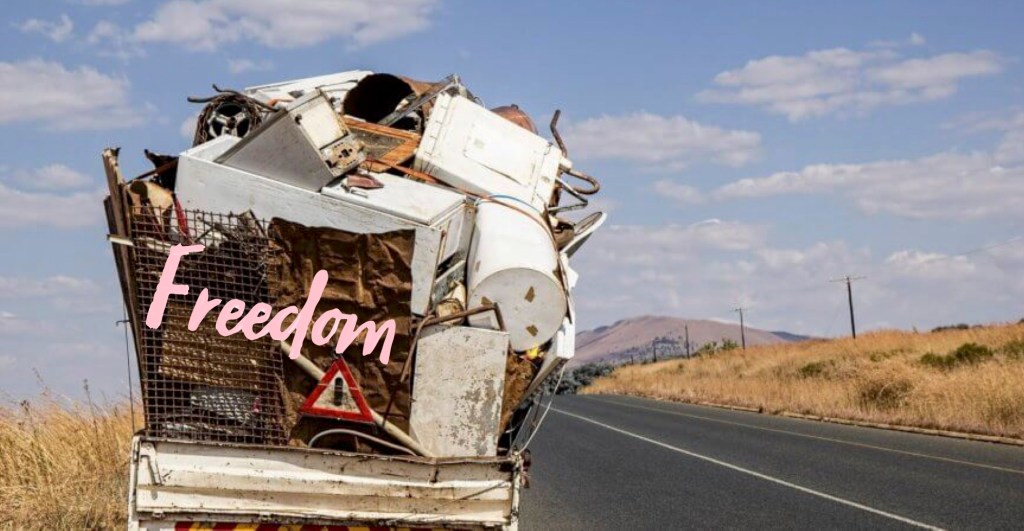
How can you visualise Freedom in a single work of art?
London, May 1, 2024 – Refugee Artists create a live sculpture on the theme of Freedom during Kensington & Chelsea Art Week
“Freedom’s just another word for nothing left to lose, Nothin’, don’t mean nothin’ hon’ if it ain’t free,” sang Janis Joplin, topping the US charts in 1971 a year after her death.” The song “Me and Bobby McGee” tells the tale of two drifters, singing as they hitch a ride on a truck across the American South and West, before sadly parting ways in California.
The attraction of discovering oneself on a meandering journey across a country, a continent, or an ocean, is part of our collective human mythology, stretching back from the earliest nomadic groups, via explorers terrorising new lands, hobos jumping freight trains, hippy trails across the East, to today’s digital nomads armed with laptops and lattes. The technology and intimate knowledge of the planet have changed, but the essential core of the journey remains: to feel free to go wherever one chooses, and hopefully develop a fresh perspective of self and the universe along the way. The privilege inherent in the ability to cross the globe’s exclusive boundaries with “freedom of movement” is immense – held by a dwindling 1% minority of the globe. To paraphrase Matthew 19:24, it is easier for a war criminal to pass through passport control than for an abused woman fleeing a war zone to legally enter safe territory.
Refugees and other displaced persons, such as the collective of female artists known as Refugee Art Works (RAW) – who will create the live sculpture during Kensington and Chelsea Art Week in June this year – don’t have self-discovery, retreats, or sightseeing high on their list. Theirs are not journeys of choice but of necessity. What they share with Bobby McGee is a desire to be free from whatever they left behind: War, Abuse, Disaster. And the many ways in which the basic human rights to enjoy justice, peace, equality, and the right to choose how and with whom to live, are restricted arbitrarily by others.
RAW was founded by Karmabank, a non-profit based in West London, to support female refugee artists from seven countries who arrived in London seeking safety. Karmabank has provided RAW artists with education and studio space opportunities at the Slade School of Fine Art, with seed funding, and with materials and logistics support to get their work produced, shown and sold at international art fairs. During Frieze Week in 2023, RAW was selected as the charity partner for the 10th annual StART fair, presenting works at the Saatchi Gallery. The previous year they were featured on the BBC’s coverage of The Other Art Fair at the Truman Brewery. For this year’s Kensington & Chelsea Art Week (KCAW), and London Refugee Week (which occurs around the same time in June), the artists will create a joint sculptural work, on the theme of “Freedom”, which begs the question: how can a single work of art accurately express this powerful concept?
Refugees would seem ideal for the task: they have an intimate knowledge of how it feels to lose freedom and how that loss leads them to go on the road to seek sanctuary, sometimes for years in miserable conditions before being able to secure a safe haven. Refugees and displaced persons are the collateral damage of geopolitics, of slides to the right, of intolerance, and disasters. Those enshrined forever on the Statue of Liberty as “your tired, your poor, your huddled masses yearning to breathe free, the wretched refuse of your teeming shore…the homeless, tempest-tost.” The poet and activist, Emma Lazarus, was inspired by her work with refugees from the Russian pogroms and her Sephardic Jewish roots, but like Joplin’s posthumous success with McGee, Lazarus’ work was not attached to the “Mother of Exiles” until 17 years after her death. Thanks in part to her poem, the 93 metre high Statue of Liberty, completed in 1886, now potently embodies “Freedom” like no other work of art.
For a Saudi Arabian LGBT teenager fleeing an abusive forced marriage, or a Ukrainian artist lamenting her parents entrapment inside Russian-occupied areas of her bombed country, Freedom is something taken from them, and something they have to request to regain their rights as legal human beings. A disabled female Iranian artist knows intimately the struggles to achieve the same freedom of movement – and of clothing – enjoyed by the able-bodied, and male. Those on the right of the political spectrum who fear an insidious Wokerati will steal their rights to say or do what they feel, the right to shout loudly about the ways refugees are taking their way of life, do so from the safety of their position as citizens with full benefits, and in full ignorance of the flip side of rampant “freedom” in their understanding – the trampling of the rights of more vulnerable members of society, and the tacit acceptance of the morally unjustifiable collateral damage that drives displacement. Freedom can be just another word for tyranny, without limitations that safeguard those who most deserve to be free.
How RAW artists will create their take on Freedom – in the form of a sculpture made from waste and scrap materials found in the local area – will be revealed in June. The collective work will be presented live as a performative installation experience, in a former car garage turned art foundation. The surrounding area’s eclectic mix of mechanic shops with piles of rusting vintage cars, council estates traumatised by the Grenfell tragedy, a travellers’ camp, and dub and punk legends (the Clash recorded “Combat Rock” during the area’s brief period as the independent Republic of Frestonia) is ripe for regeneration. This year’s theme of KCAW is “Changing Landscapes” and that of Refugee Week is “Our Home” – themes that reflect a refugee’s need for regeneration in a safe space. Lazarus compared refugees to life’s discarded waste in The New Colossus. Through re-purposing waste materials into art, the refugee artists give value to our discarded things, much as they seek to rebuild their lives.
###

Leave a comment